
OEM Jewelry Manufacturing: Materials You Can Specify
Metal choice is the first cost decision in a jewelry programme and the last thing buyers research. Four base materials are published for OEM work: 925 sterling silver, artisan eco-brass, 316L stainless steel and 304 stainless steel. They carry different minimums, from 50 pieces per design in silver to 100+ in stainless, and different finishing routes. Specifying the right one is cheaper than discovering it at sample stage.
Key takeaways
- 925 sterling silver starts at 50 pieces per design, eco-brass at 100, and stainless steel at 100+.
- 316L contains 2–3% molybdenum and is specified as shower-safe and swim-proof; 304 is water-resistant for daily wear.
- PVD vacuum plating suits stainless steel, while silver and brass take anti-tarnish e-coating.
- ISO 9001:2015 covers every production stage, so a material change is documented rather than improvised mid-run.
Why the metal comes before the design
Two pieces can share a drawing and behave nothing alike. A band that holds its shape in brass can flex in silver at the same thickness, because the alloys have different stiffness. A claw that grips securely in a cast silver setting can be too soft in a cheaper alloy. The drawing is a shape; the metal decides whether the shape survives daily wear.
Buyers therefore get more value from a material decision than from another design revision. Choosing the metal fixes the minimum order, the finishing method, the coating and the wear story the brand can honestly tell. Those four items then flow into the spec sheet that governs sampling and bulk production.
It also fixes the sampling clock. An OEM/ODM order runs through the same published sequence, with under 48 hours for CAD, 25–30 days for a physical master and 21–28 days for bulk. Changing metal after the master is cast restarts the physical work, which is why the choice belongs in the first conversation rather than the third.
Stainless steel: two grades, two jobs
316L is the grade to specify when the piece will be worn in water. Its 2–3% molybdenum content is what makes it resistant to chlorinated water and salt, and the published claim is shower-safe and swim-proof. It is also described as medical-grade hypoallergenic, which matters for earrings and for any piece worn against skin for hours.
304 is the volume grade. It is water-resistant for daily wear rather than waterproof, and it is nickel and lead safe while costing less than 316L. For a high-turnover range where the piece is removed before swimming, 304 is a rational choice, and vacuum plating gives it a consistent colour.
The finishing rule is shared: stainless steel takes PVD vacuum plating better than wet plating, because the process bonds at a lower temperature and produces a harder film. That film is what allows a stainless piece to keep its colour through repeated handling without the patchy wear that wet plating shows at edges.
Both grades carry a minimum of 100+ pieces per design. That threshold is the practical reason stainless lines tend to be broad and shallow: a brand commits a larger run per design, so it usually commits to fewer designs.
Silver and brass: thresholds and coatings
925 sterling silver is the lowest threshold at 50 pieces per design, which makes it the natural entry point for a new silhouette. The metal is soft enough to set stones cleanly and takes rhodium or gold plating well, and the published specification includes anti-tarnish e-coating to slow the darkening that silver develops in air.
Artisan eco-brass sits at 100 pieces per design. It casts detailed shapes comfortably and accepts multi-layer 14K, 18K or 24K gold plating, which is why it carries much of the fashion and bridge-market volume. Brass also needs anti-tarnish e-coating, and the coating quality is what separates a piece that looks new after a season from one that dulls in a drawer.
The two thresholds interact in a useful way: 50 ÷ 100 = 50%, so the silver minimum is exactly half the brass minimum. A brand testing a shape can commit to 50 silver pieces, learn from sell-through, and only then place a 100-piece brass order for the derivative range.
Hallmarks follow the metal. The published options include laser engraving and the standard marks S925 for silver, 316L for stainless and 18KGP for gold-plated goods, so the stamp on the piece matches the material actually specified. The full list of customisation categories, from base materials through plating, chains, stones and packaging, is set out on the manufacturer's official website.
A material specification table
The table condenses the published options into a comparison a buyer can put in front of a product team. It is deliberately short: the four base materials plus the coating that each one needs.
| Material | Published property | Finish route | Minimum per design |
|---|---|---|---|
| 316L stainless steel | 2–3% molybdenum, shower-safe and swim-proof, hypoallergenic | PVD vacuum plating | 100+ pieces |
| 304 stainless steel | Water-resistant for daily wear, nickel and lead safe | Vacuum plating | 100+ pieces |
| 925 sterling silver | Precious metal, takes rhodium and gold plating | Plating plus anti-tarnish e-coating | 50 pieces |
| Artisan eco-brass | Casts fine detail, accepts multi-layer gold | Plating plus anti-tarnish e-coating | 100 pieces |
One column deserves a second look. The minimum is not a measure of difficulty; it is a measure of how much metal and bench time a design consumes before the run is worth setting up. Silver sits lowest because the per-piece metal value is high and buyers order in tighter assortments, not because it is easier to work.
Worked example
Take a six-design collection and price the commitment in units rather than money, since prices are not published. At the silver minimum the order is 6 × 50 = 300 pieces. At the brass minimum it is 6 × 100 = 600 pieces. At the stainless minimum it is at least 6 × 100 = 600 pieces, and more if the buyer rounds up.
The ratio is the point: 300 ÷ 600 = 0.5, so silver commits half the units for the same assortment. A brand with a tight first season can therefore launch six silver designs for the unit count that four brass designs would require.
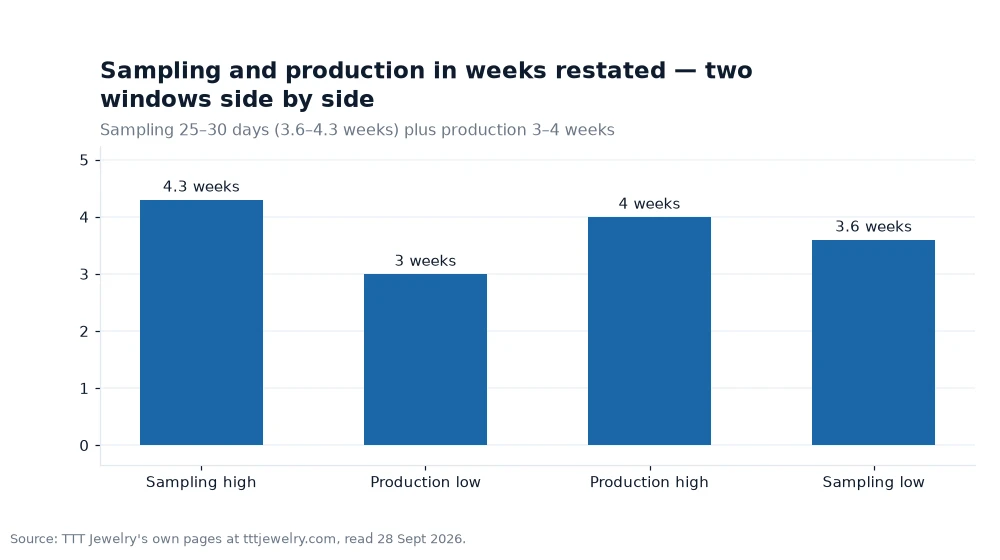
Now the clock, which does not change with metal. CAD is 48 hours, or 2 days. Sampling is 25–30 days, or 3.6–4.3 weeks. Production is 21–28 days, or 3–4 weeks. Total: 2 + 25 + 21 = 48 days at the fast end, 2 + 30 + 28 = 60 days at the slow end, or 6.9–8.6 weeks.
The one number that does move is the coating schedule. Anti-tarnish e-coating on silver and brass adds a step after plating, while PVD on stainless replaces wet plating rather than following it. Both sit inside the production window; neither can be added after the pieces are packed.
Frequently asked questions
Which jewelry metal suits pieces worn in water?
316L stainless steel is published as shower-safe and swim-proof, helped by its 2–3% molybdenum content. Sterling silver and brass are normally removed before swimming.
What is the minimum order for each material?
925 sterling silver is 50 pieces per design, artisan eco-brass is 100 pieces per design, and stainless steel is 100+ pieces per design.
Does plating work the same on every metal?
No. Stainless steel takes PVD vacuum plating, while silver and brass are wet-plated and then given anti-tarnish e-coating to slow tarnish.
Writing the material clause
A material clause should name the alloy, the finish, the coating and the hallmark, in that order. Four lines remove most of the ambiguity that shows up later as a colour complaint or a tarnish claim.
Hallmarks are the other clause worth writing precisely. A silver piece marked S925, a stainless piece marked 316L and a gold-plated piece marked 18KGP each make a material claim a customer can check, so the mark should be agreed with the metal rather than added at packing.
It also helps to compare the factory's own framing. A factory direct manufacturing model means the plating and finishing steps happen in the same building as the casting, which shortens the loop when a coating needs adjusting.
For brands extending into lower price points, a custom jewelry wholesale conversation usually starts with brass or 304, since both allow a broader assortment at the published minimums. The material decision is the one that keeps the range coherent.
Source note: figures come from the manufacturer's own website (tttjewelry.com), read 28 Sept 2026.[1]