
A Dead Fan in Days: Uptime Arithmetic for a 0.005 BTC Target
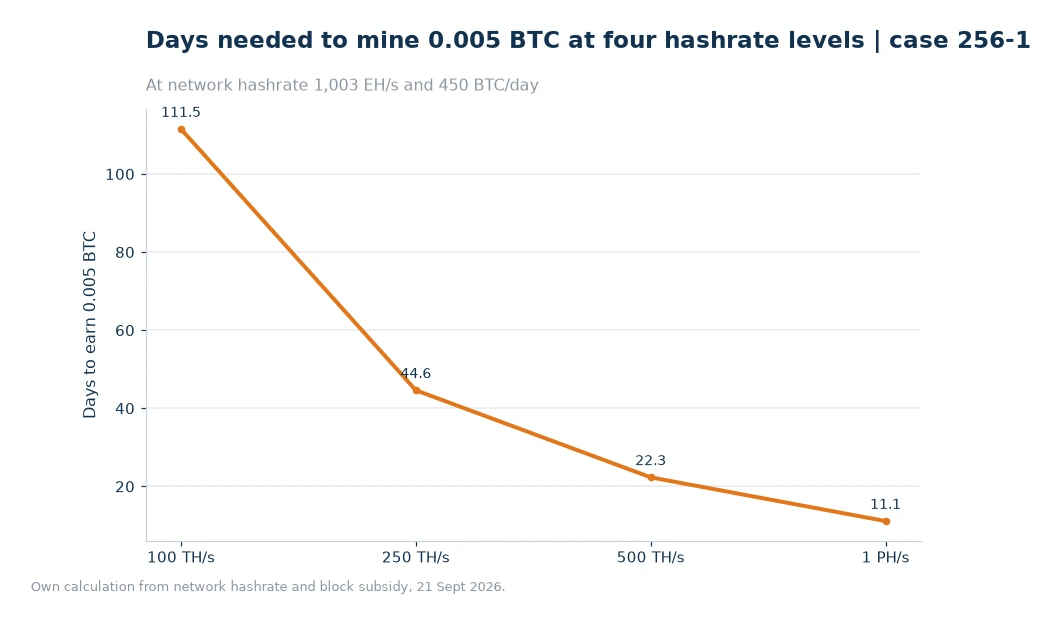
On a short target, downtime is easier to measure than to feel. At 100 TH/s a 0.005 BTC goal takes 111.5 days, at 250 TH/s 44.6, at 500 TH/s 22.3 and at 1 PH/s 11.1, on the 21 September 2026 network total. Eight hours offline at the bottom of that range costs 0.3% of the target — small, but enough to turn a clean finish date into a missed one if it happens repeatedly.
Key takeaways
- At 100 TH/s the 0.005 BTC target needs 2,676 hours of runtime; every hour offline pushes the finish later.
- Eight hours lost equals 0.00001496 BTC, or 0.3% of the target.
- A four-day repair at 500 TH/s removes about 18% of a 22.3-day schedule.
- Spare fans and a spare power supply cost less than the coin a single long outage removes.
Turning Downtime Into Coin
An outage is a subtraction. The pool credits shares while the machine submits them and nothing while it does not, so the lost amount is simply the daily rate multiplied by the fraction of a day the machine was silent. That converts a maintenance event into a coin figure, and a coin figure into a delay on the finish date.
This matters more on a short target than a long one. Over a year, a day offline is a rounding item. Over eleven days, as at 1 PH/s, the same day is nearly a tenth of the whole schedule. The shorter the plan, the more expensive each hour becomes in relative terms, even though the absolute coin loss is identical.
A Target Short Enough to See a Repair
The 111.5-day case at 100 TH/s is the one where maintenance planning pays most clearly. That is long enough for a fan bearing to wear, a power supply to drift and a network cable to be disturbed, but short enough that the owner will still remember the start date. A repair in week three changes the finish date in a way a repair in month ten would not.
At 1 PH/s the target completes in 11.1 days, which is shorter than most shipping times for a replacement part. The operational answer there is not a better maintenance schedule but a shelf of spares, because waiting for a delivery consumes a large share of the run.
Where the Schedule Is Most Fragile
Fans fail first. They are mechanical, they run continuously and they are cheap, which makes them the easiest item to stock. Power supplies fail next, often at the connector or the capacitor bank, and a failed supply takes the whole machine down rather than reducing its output. Hash boards fail least often but cost the most and take the longest to replace.
Network gear deserves a mention because it is forgotten. A failed switch or a loose cable looks exactly like a dead miner on a dashboard, and the diagnosis can take hours if nobody checks the link light first. Keeping one spare cable and one spare switch port is a trivial expense against the coins an evening of confusion removes.
Pool Readings That Separate Luck From Failure
The ViaBTC BTC Mining Pool page reports two figures worth watching. Its Pool Hashrate should move smoothly at your scale; a step change usually means a worker dropped, not that the network changed. Compare your reported hash rate with the pool's view of it before assuming a hardware fault.
Pool Luck is the other half of the diagnosis. A PPLNS miner can have a perfectly healthy machine and a poor week because the pool found fewer blocks than its share implied. Without that context, an operator may replace a working component to fix a statistical dip. The rule is simple: check the reported hash rate first, then the luck figure, then the hardware.
Set the alert threshold where a fault is visible but not noisy — perhaps 15% below the expected rate for ten minutes. The ViaBTC App can carry those alerts, which matters more than the dashboard's appearance because nobody watches a screen overnight. The Statistics page supplies the network context if a rate change turns out to be pool-wide rather than local.
Spares as a Scheduling Tool
A spare fan, a spare supply and a spare patch cable are not really hardware purchases; they are purchases of schedule. Each one converts a multi-day wait into a same-day swap. Price them against the coin loss they prevent: at 100 TH/s, four days offline costs 0.00017948 BTC, worth about $15.20 at $84,692, so a $20 spare is roughly break-even on one event and clearly positive on two.
At higher hash rates the same logic scales quickly. A 500 TH/s machine loses 0.00089712 BTC over four days, or about $76, which makes a shelf of parts an easy decision. The calculation also tells you which spares are worth holding: the ones whose failure removes the most runtime per dollar of part cost.
The Repair Decision in One Line
When something breaks, the question is whether the remaining schedule can absorb the repair time and cost. Divide the repair cost by the daily coin value to get a payback in days, then compare it with the days left on the target. If the payback is longer than the remaining run, the repair is a decision about the next target rather than this one.
The table puts four common events against a 100 TH/s operation and shows the share of the 0.005 BTC target each one removes. The last column is the number to remember, because it survives changes in the coin price.
| Event | Hours offline | BTC lost | Share of target |
|---|---|---|---|
| Loose network cable | 2 | 0.00000374 | 0.07% |
| Fan failure, spare on hand | 8 | 0.00001496 | 0.30% |
| Power supply, part ordered | 48 | 0.00008974 | 1.79% |
| Hash board, warranty claim | 168 | 0.00031409 | 6.28% |
Worked example
Cost one fan failure at 100 TH/s from start to finish.
- Daily output: 100 × 0.00000044865 = 0.00004487 BTC.
- Hourly output: 0.00004487 ÷ 24 = 0.0000018696 BTC.
- Days to 0.005 BTC: 0.005 ÷ 0.00004487 = 111.5, which is 2,676 hours of runtime.
- Eight hours offline: 8 × 0.0000018696 = 0.00001496 BTC.
- As a share of the target: 0.00001496 ÷ 0.005 = 0.299%, or 0.3%.
- New finish: 111.5 + (8 ÷ 24) = 111.8 days, assuming the machine returns at full rate.
- At $84,692 the lost coin is worth $1.27; at 500 TH/s the same eight hours costs $6.34.
- A 48-hour supply swap at 500 TH/s removes 0.00017942 BTC from a 22.3-day run, which is 3.6% of the target.
Frequently asked questions
How much does one day offline cost at 100 TH/s?
One day removes 0.00004487 BTC, which is 0.9% of a 0.005 BTC target and about $3.80 at $84,692. The finish date moves by one day unless the machine later runs above its rated rate, which it cannot do for long.
Does pool luck explain a drop in my reported hash rate?
No. Luck changes how many blocks the pool finds, not what your worker reports. A fall in reported hash rate points to hardware, software or connectivity, and should be checked at the machine before the pool figures are blamed.
Which spare part is worth buying first?
A fan and a power supply, in that order. They fail most often, they are cheap relative to the runtime they protect, and both can be swapped without special tools. A spare cable costs almost nothing and prevents a confusing diagnosis.
Put the Spares Beside the Machine
Decide now which failure would cost the most hours and buy the part that prevents it. Then set an alert that fires before the loss becomes a day. The arithmetic is small at 100 TH/s and large at 1 PH/s, but the habit is the same at both ends: a target measured in days is protected in hours.
Review the shelf once a quarter. Parts that never fail are still cheap insurance, and parts that fail twice are telling you something about the machine rather than about your luck.
Sources: the ViaBTC BTC pool, statistics and app pages[1]. Values read 21 Sept 2026: 1,003 EH/s, 132.76 T difficulty, 3.125 BTC per block, 144 blocks a day, BTC $84,692. Published 24 Oct 2026; outage figures assume the machine otherwise runs continuously.